
Advancing Biogas Knowledge in Catalonia: From Introduction to Capacity Building
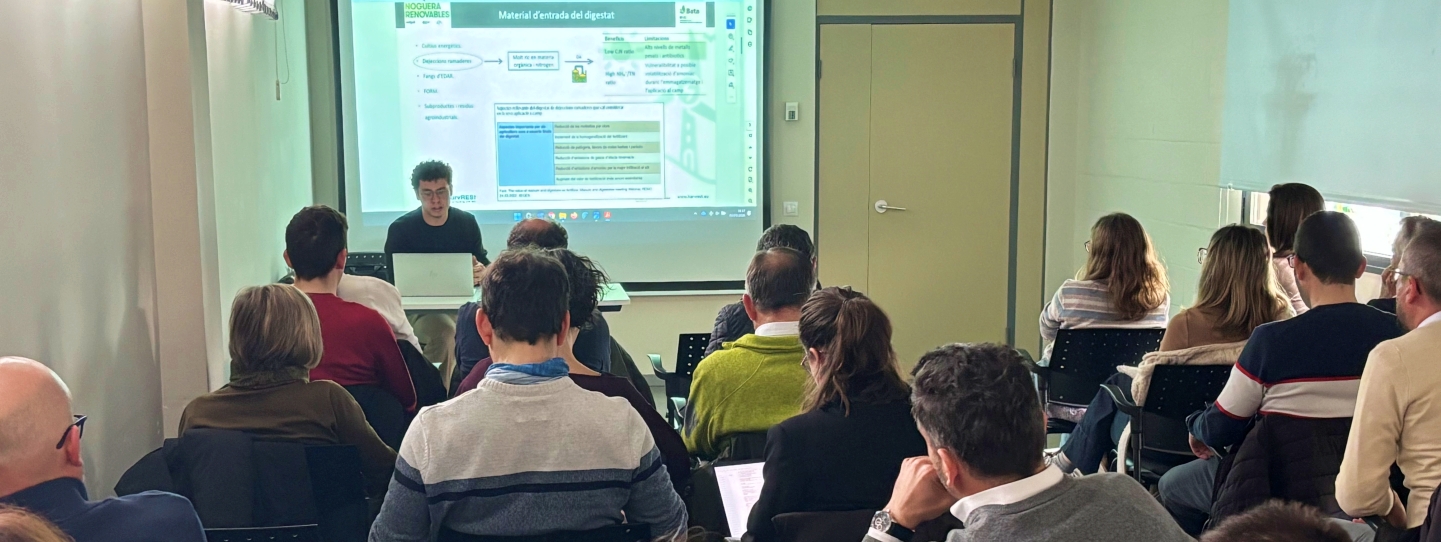
On 3 March 2026, partners from the HarvRESt project organised a dynamic workshop at Sorigué’s facilities near Balaguer, Catalonia, bringing together 29 stakeholders from across the agricultural, research, public administration, waste management, agri-food and energy sectors.
The event, titled “Biogas development in Catalonia: farm production of renewable energy and improvement of environmental sustainability through digestate treatment and use,” combined a warm-up session and a capacity-building programme designed to foster dialogue and strengthen knowledge around farm-scale biogas production and nutrient recovery.
A warm-up to set the scene
The workshop began with a warm-up session aimed at introducing participants to the HarvRESt project and the broader context of biogas development in Catalonia. Through four presentations, speakers explored the key dimensions of implementing biogas systems on farms, highlighting their potential to simultaneously generate renewable energy and produce bio-based fertilisers from digestate.
The session opened with a general presentation of the HarvRESt project, followed by insights into the Catalan biogas landscape and practical experiences from the Noguera Renovables initiative. Speakers also addressed the integration of energy production with biofertiliser generation, as well as the agronomic aspects of using digestate in the field. These contributions provided participants with an overview of the technical, environmental and regulatory aspects involved in farm-scale biogas projects.
Beyond the presentations themselves, the warm-up session served as an important networking platform. Participants from different sectors exchanged perspectives and identified opportunities for collaboration. Several attendees also highlighted that they gained new insights into emerging regulations, technologies for digestate treatment, and the potential for improved residue valorisation within circular agricultural systems.
Building capacity through dialogue and expertise
Followingly, the workshop moved into the capacity-building session, which focused on practical knowledge and real-world implementation challenges. Four expert presentations addressed key topics: the technical management of farm-based biogas plants, the policy framework for biogas development in Catalonia, economic considerations such as investment and operational costs, and the environmental benefits of anaerobic digestion.
Participants were highly engaged throughout the session. Instead of waiting for a final debate, lively discussions emerged after each presentation, creating an interactive learning environment. Farmers, researchers and industry representatives actively shared their experiences and raised questions related to digestate management, biomethane market value and the practical challenges of implementing biogas projects on farms.
One key discussion point was the importance of managing manure and slurry quickly in anaerobic digesters to prevent methane emissions from conventional storage. Participants also emphasised that the economic viability of biomethane production can be strongly influenced by certification systems and the value assigned to avoided greenhouse gas emissions.
Overall, the workshop demonstrated strong interest in biogas solutions within the Catalan agricultural sector. By combining introductory insights with practical capacity building, the event created a valuable space for knowledge exchange, reinforcing the role of collaboration between farmers, researchers, policymakers and industry actors in advancing sustainable bioenergy systems.