
Co-creating Policy Pathways for Integrating Renewable Energy into European Farming
On 26 March 2026, the HarvRESt project convened its second Visioning Policy Lab, bringing together policymakers, territorial authorities, researchers, and practitioners from across Europe.
Held online, this participatory workshop focused on a central challenge for Europe’s green transition: how policy can enable the sustainable integration of renewable energy sources (RES) into agro-farming in Europe.
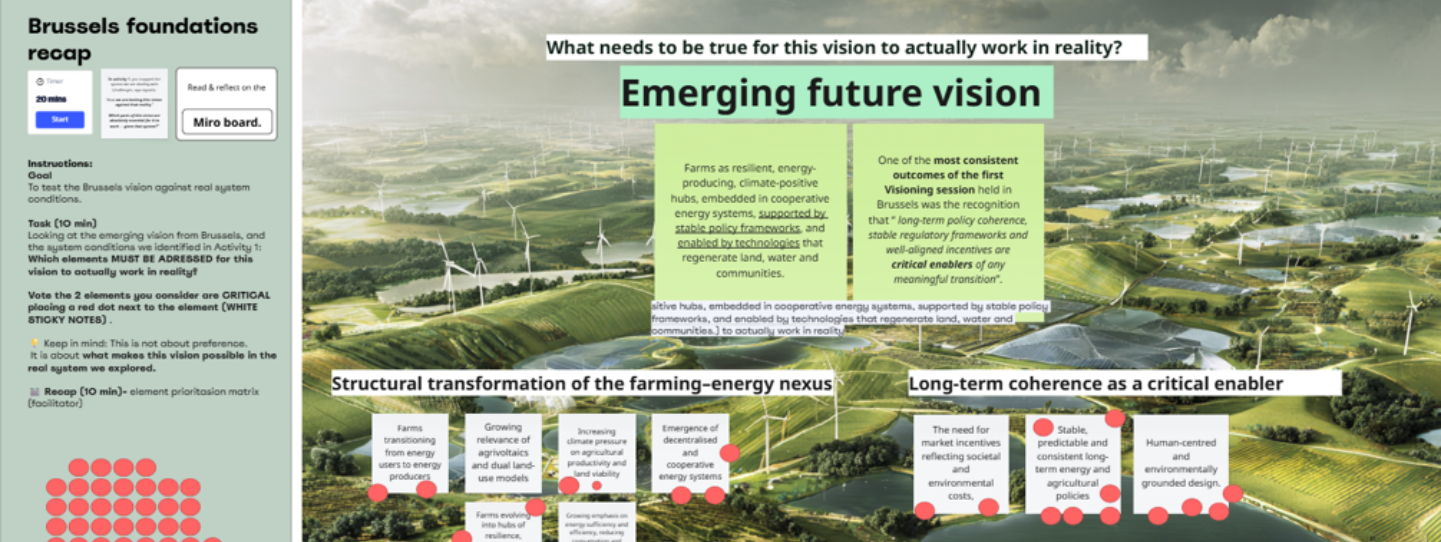
Building on the outcomes of the first Policy Lab held in December in Brussels, this second session refined a shared vision for 2035, moving beyond innovation pilots to explore the policy conditions, governance models, and business frameworks required for systemic change.
Four pillars for policy action
Discussions throughout the Lab converged into four interconnected pillars that participants identified as essential for policy progress:
- Policy making — Coherent, integrated, and territorially adapted frameworks.
- Viable business models — Economically sustainable farming supported by stable financial mechanisms.
- Cooperation across stakeholders — Trust based collaboration across sectors and governance levels.
- Local ownership — Community control and agency over energy and food systems.
Together, these pillars reflect a shift from sector specific instruments toward integrated, place-based policy design.
1. The transition is systemic – not merely technological
A central insight from the workshop was that renewable energy integration in agriculture is not primarily a technology challenge but is systemic and one of governance.
Participants highlighted persistent disconnects between energy, agricultural, climate, and territorial policies, which create uncertainty and friction at farm level. They also stressed that one size fits all solutions do not work: feasibility and impacts vary significantly depending on farm type, scale, and local context.
2. Policy stability is the backbone of investment
Policy instability was identified as an important barrier to farmer engagement in renewable energy.
Key challenges included high upfront capital costs, regulatory complexity, lengthy and fragmented permitting procedures, and legal or fiscal uncertainty—particularly regarding taxation and long term revenue conditions. Frequent policy changes disproportionately affect farmers, who are often risk averse and operate on long investment horizons.
3. Financial viability and business models matter more than ambition
The Lab reinforced a critical message: climate ambition alone is not enough if farm economics do not work.
Renewable energy must enhance, not jeopardise, the core mission of farming: food production. This requires integrated business models where energy is treated as a co product of farming, rather than an add on or competing activity.
4. Cooperative and territorial models are key enablers
One of the most positive signals to emerge from the Policy Lab was the growing role of cooperative and territorial energy models.
Energy cooperatives were seen as powerful tools for risk sharing, local ownership, and value retention in rural areas. Crucially, territorial legitimacy depends on farmer participation, equitable benefit sharing, and visible local outcomes.
Participants increasingly framed farms as resilient territorial hubs, connecting food, energy, and community services.
Next steps
After the visioning sessions, two more steps will help the HarvRESt project build a policy roadmap for RES in farming:
- Pathways to innovate: 21 May
- Roadmap for 2025-2035: 11 June
Building on these insights, industry actors, policymakers, territorial authorities and researchers are invited to co-build and map pathways for innovation in this field (21 May). These workshops will be consolidated into a final workshop (11 June) to define a roadmap for policy building in Europe.
We hope you will join us!