
From Sunlight to Smart Irrigation
New HarvRESt research is changing how farms think about the energy behind their water
It is the middle of the day on a vineyard in Spain, and the irrigation pumps are working hard. The sun is high, the vines are thirsty, and in the background a meter is quietly ticking over. For a growing number of farmers, this is the daily balancing act: keeping the crop watered while keeping a wary eye on the electricity bill.
Solar power looks like the obvious answer. It is clean, increasingly cheap, and it lets a farm generate its own electricity rather than buying every kilowatt from the grid. But there is a catch that anyone who has worked the land will recognise at once. The sun does not always shine when the water is needed, and the water is not always needed when the sun shines.
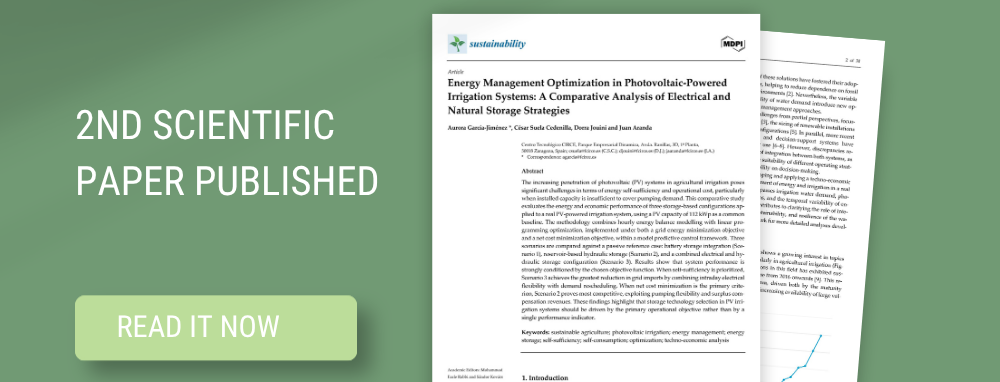
A newly published study from the HarvRESt project, by CIRCE Research Center, which appears in the journal Sustainability, takes this everyday mismatch seriously. Rather than treating it as a neat engineering puzzle, the researchers approach it as a real-world problem in which energy, water and the rhythms of farming all have to work together.
When renewable energy meets real farming
On paper, solar-powered irrigation is a near-perfect partnership. It cuts emissions, reduces reliance on fossil fuels, and gives a farm a degree of independence it never had before.
In practice, things are messier. Generation peaks around midday and fades to nothing after dark, while irrigation demand follows the crop, the weather and the way the farm is actually run. The result is a gap between when energy is produced and when it is wanted, and that gap eats into both efficiency and profit.
The question the HarvRESt team set out to answer was a practical one: what is the best way to close it?
Putting the ideas to the test on a working vineyard
The study is grounded in a real installation, not a spreadsheet. The case study farm is a Spanish vineyard with a 112 kWp solar array and six pumps, but no way of storing the energy or the water it moves.
Whatever the panels generate is either used on the spot or sold back to the grid.
Against that starting point, the researchers modelled three ways of storing what would otherwise be lost:
- putting the surplus into batteries;
- pumping water into a reservoir to be used later;
- combining both approaches.
Each option was judged against two very different goals. Could it make the farm more self-sufficient and less dependent on the grid? And could it bring the running costs down? Crucially, the team modelled the system hour by hour across a full year, so they could see how a decision made at one moment, when to run a pump or when to charge a battery, ripples through the rest of the day.
A question of priorities, not technology
What comes out of the analysis is not a single winning solution, but something more useful: it depends on what the farmer is trying to achieve.
If the aim is energy independence, using as little grid electricity as possible, then combining a battery with a reservoir gives the most room to manoeuvre. Energy captured during the sunniest hours can be banked and spent later, moving the farm closer to standing on its own.
If the aim is to spend less, the picture flips. Here a reservoir on its own proves the more competitive choice. By pumping water when solar energy is plentiful or electricity is cheap, the farm makes real savings without the added cost and complexity of a battery. In fact, the study found the water-tank option paid for itself in a little over eight years, while the battery, on its own, did not stack up financially given current prices.
Better decisions, not just better kit
Perhaps the most valuable thing the study offers is not the comparison itself but the way of thinking behind it. There is no one-size-fits-all formula for bringing renewable energy onto a farm. Local conditions, regulations and a grower's own priorities all change the answer, and what works in one valley may not work in the next.
This is exactly where the wider ambition of HarvRESt comes into focus. The project is not only about installing solar panels and pumps; it is about helping farmers make smarter calls through data, modelling and a view of the whole system. Tools such as the project's Agricultural Virtual Power Plant are being built with precisely that goal, to help growers and advisers weigh up the trade-offs between cost, sustainability and performance, rather than guessing.
A step towards climate-neutral farming
The findings feed into a much larger shift now under way across European agriculture. Bringing renewable energy into farming can lower its environmental footprint, make better use of scarce resources and open up new economic opportunities. It also adds complexity that no single piece of equipment can resolve on its own.
By pairing real-world data with advanced modelling and a hard look at what actually happens on the ground, HarvRESt is helping to turn a good idea into something a farmer can put to work.