
Making RES Training Practical: HarvRESt Capacity Building Across the Use Cases
In spring 2026, HarvRESt advanced its work on supporting the integration of renewable energy in agriculture by implementing a series of capacity-building activities across its Use Cases. Between March and May, six training activities were organised in Italy, Denmark, Spain and Norway, reaching 309 participants from the agricultural sector, research, public administration, advisory services, industry, energy planning, investment and local communities.
The purpose was to empower farmers and rural stakeholders to better understand what renewable energy integration can mean in practice at farm level. This included not only the technologies themselves, but also the environmental, regulatory, financial and organisational questions that influence not only whether such solutions can actually be adopted, but also how they can be implemented and integrated into different local contexts.
A shared training base, adapted to each context
To support the workshops, HarvRESt developed five training modules covering the main dimensions of renewable energy uptake in agriculture: technical aspects, environmental and sustainability considerations, policy and regulatory frameworks, business models and financial mechanisms, and stakeholder engagement and market research.
The modules provided a common base for the project, but they were not used as a fixed package. Each Use Case selected and adapted the material according to its local context, the technology being demonstrated and the profile of participants. This was important, as the training needs of stakeholders discussing biogas planning in Denmark are not the same as those of participants looking at agrivoltaics in vineyards or digestate management in Catalonia.
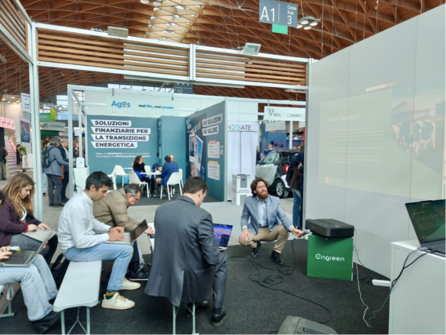
Photo: Italian Use Case capacity building workshop
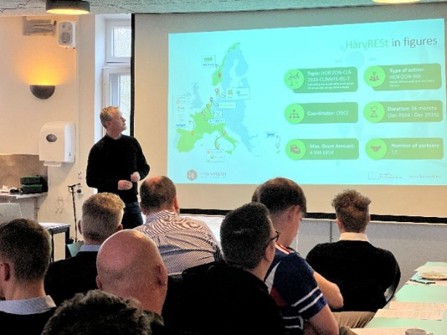
Photo: Danish Use Case capacity building workshop
From fairs to farms, and from tools to demonstrations
In Italy, two capacity-building activities focused on renewable energy applications in agriculture, including environmental, regulatory, technical and business aspects. The first session took place at the Key Energy Fair in Rimini, which allowed the Use Case team to engage directly with actors from the energy and agricultural innovation sectors. A second online session continued the discussion, with particular attention to regulatory processes and practical implementation.
In Denmark, the workshop took place at Gråsten Agricultural School and focused on the potential for biogas production in agriculture. Participants tested a beta version of the HarvRESt biogas planning and decision-support tool using real farm data. This practical format opened useful discussions on data quality, tool usability, nutrient calculations, greenhouse gas emissions and the needs of advisors, planners and other potential users.
In the Spanish VdV-VRT Use Case, an online workshop introduced participants to renewable energy in agriculture, energy self-consumption, hybrid systems and the Agro Virtual Power Plant. The session helped connect technical concepts with real energy decision-making in agricultural settings, particularly in relation to vineyard operations and farm-level energy management.
In the Spanish ACSA Use Case, the workshop focused on biogas development in Catalonia, farm production of renewable energy and the treatment and use of digestate. Participants discussed the technical management of farm-based biogas plants, policy perspectives, economic viability and environmental benefits. The exchanges were particularly active around digestate application, biomethane certification and greenhouse gas accounting.
In Norway, the capacity-building activity was embedded in the “Future Farmer 2.0” test and learn days at Øksnevad Agricultural School. The event brought together students, farmers, local actors and agritech companies through demonstrations of digital farming tools, renewable energy solutions, drones and precision agriculture technologies. It also opened wider reflections on food, energy and water preparedness.
Key Insights from the Workshops
Across the Use Cases, the workshops revealed a similar pattern as all other engagement activities: Participants were most engaged when training was connected to concrete examples. Participants responded well to real data, demonstrations, practical cases and direct exchanges with farmers, researchers, advisors and technology providers.
At the same time, the workshops highlighted a number of areas where stakeholder are still seeking greater clarity, more in-depth knowledge, and support. Participants raised questions about permits, administrative procedures, investment costs, environmental impacts, certification systems, greenhouse gas accounting and the interpretation of decision-support tools. The persistence of these questions across different Use Cases can provide important direction for future capacity-building and knowledge-sharing activities.
The activities also highlighted the importance of tailoring capacity-building efforts to local realities. Whether discussing biogas planning, agrivoltaics, energy self-consumption or digital farming solutions, participants consistently sought practical guidance that could help them evaluate renewable energy options in their own contexts.